Thank You Mr. Penner

Loss from rear wheel to crankshaft is much smaller than expected.
And it can be measured with a dyno.
At the end of the run you pull the clutch. Now the reel is decelerated by the friction from the rear wheel the drive shaft and the transmission up to the clutch. . This loss is measured by the dyno software the same way it was when positively accelerated to get rwhp.
It is about 12 hp with a Rocket3.
 
Guys I know how to use TuneECU to do maintinance, adjust tunes and download the tunes while using a battery charger and pulling a fuse to maintain voltage. What I dont know how to do is delete tunes either in the download file or in my saved tunes files. I have several tunes I don't need anymore and would like to delete them.
If you don't want to use a tune anymore and can't figure out how to delete it, nothing stops you from renaming it to "Do Not Use" in your saved tunes file.

Generic instructions for deleting tune files are as follows:

Android (most common TuneECU platform)​

  1. Open your phone’s (device) File Manager.
  2. Go to the folder where TuneECU stores maps:
    • Usually /Documents/TuneECU/ or /Download/
  3. Long‑press the map file (.hex, .bin, .map) you want to remove.
  4. Tap Delete.
This removes the file.
 
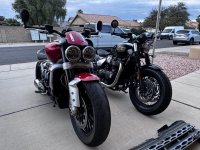
Hello, this is how i've built serous power with the my 2020 R3.
It started with a Penner map tune, then I installed
Vandemon-Stealth E-Valve Titanium Slip-On Mufflers, headers and a DNA filter.
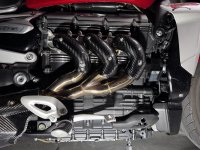
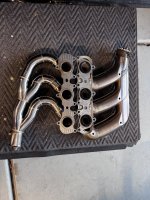
The Vandemon headers flow 14% more air, as you can see from the photos. Intake runners were polished.
I have installed a wideband O2 sensor in the Vandemon exhaust right after the header collector.
This was for fine tuning the fuel/air ratios.

Penner has done a great job with the map program, "Thank you Mr.Penner” .

I have the wideband O2 sensor connected to a Fueltech Nano-Pro controller used for monitoring O2 in the exhaust.
This controller has a data logger to review after each ride.
I have attached the specs on the exhaust system, and Headers,

Stealth E-Valve Titanium Slip-On Muffler, Production years: 2020-2022
  • O2 sensor provision M12x1.25
  • Power +54% Torque@2500rpm & +25% Hp@6760rpm
  • From 133hp to 165hp@6760rpm
  • From 120nm@2500rpm to 185nm@2500rpm
  • Peak Torque From 172nm@5380rpm to 200nm@3870rpm
  • Performance figures achieved after flash tune & DNA air filter
Triumph, Stainless steel exhaust manifold.
  • Exhaust Port I/D 15% larger than OEM
  • Discharge Port I/D 9% larger than OEM
This set-up, Significantly improves exhaust flow efficiency by creating a low-pressure area (mild venturi effect)
as exhaust gases pass each cylinder exhaust port.
This characteristic is essential for enhancing engine volumetric efficiency, something that the OEM 3-into-1 manifold cannot achieve.
This Performance eliminates all restrictions.
Im setting right at about 180HP and 190Lbs Ft of torque.
No drivability issues, and no check engine light……...
This Rocket, Likes to run. Like a raped ape
Total cost to date $4000.00
Rear tires every 3000 miles. 12,600 miles, and never ran better.

 

Attachments

  • IMG_9377.jpeg
    IMG_9377.jpeg
    234.2 KB · Views: 9
  • IMG_9183.jpeg
    IMG_9183.jpeg
    230 KB · Views: 9
  • IMG_9176.jpeg
    IMG_9176.jpeg
    275.2 KB · Views: 9
Will you repeat the tip Neville told you about increasing oil flow in head passage, got mine down now so might be a good time to do it.
Well it has been some time since doing this little trick Neville told me on a phone call. In the head or block ( can't remember just where) is an oil feed port that has a removable "stint" that controls the oil flow to the head and particularly the cams. The stint has an allen key inner so it can be removed from the engine. Remove it and drill it out ever so slightly larger. Re-install. Thats is it.

Edit: I remember now (I think). The oil port with the flow stint is under the cam ladder in the rear of the engine.
 
Last edited:
Well it has been some time since doing this little trick Neville told me on a phone call. In the head or block ( can't remember just where) is an oil feed port that has a removable "stint" that controls the oil flow to the head and particularly the cams. The stint has an allen key inner so it can be removed from the engine. Remove it and drill it out ever so slightly larger. Re-install. Thats is it.

Edit: I remember now (I think). The oil port with the flow stint is under the cam ladder in the rear of the engine.
Thank you, I remembered parts but wanted to check.
 
Hello, this is how i've built serous power with the my 2020 R3.
It started with a Penner map tune, then I installed
Vandemon-Stealth E-Valve Titanium Slip-On Mufflers, headers and a DNA filter.
The Vandemon headers flow 14% more air, as you can see from the photos. Intake runners were polished.
I have installed a wideband O2 sensor in the Vandemon exhaust right after the header collector.
This was for fine tuning the fuel/air ratios.

Penner has done a great job with the map program, "Thank you Mr.Penner” .

I have the wideband O2 sensor connected to a Fueltech Nano-Pro controller used for monitoring O2 in the exhaust.
This controller has a data logger to review after each ride.
I have attached the specs on the exhaust system, and Headers,

Stealth E-Valve Titanium Slip-On Muffler, Production years: 2020-2022
  • O2 sensor provision M12x1.25
  • Power +54% Torque@2500rpm & +25% Hp@6760rpm
  • From 133hp to 165hp@6760rpm
  • From 120nm@2500rpm to 185nm@2500rpm
  • Peak Torque From 172nm@5380rpm to 200nm@3870rpm
  • Performance figures achieved after flash tune & DNA air filter
Triumph, Stainless steel exhaust manifold.
  • Exhaust Port I/D 15% larger than OEM
  • Discharge Port I/D 9% larger than OEM
This set-up, Significantly improves exhaust flow efficiency by creating a low-pressure area (mild venturi effect)
as exhaust gases pass each cylinder exhaust port.
This characteristic is essential for enhancing engine volumetric efficiency, something that the OEM 3-into-1 manifold cannot achieve.
This Performance eliminates all restrictions.
Im setting right at about 180HP and 190Lbs Ft of torque.
No drivability issues, and no check engine light……...
This Rocket, Likes to run. Like a raped ape
Total cost to date $4000.00
Rear tires every 3000 miles. 12,600 miles, and never ran better.

Realizing that the answer to this question is highly subjective, but how does the sound/volume compare to stock with the E-valve enabled vs. disabled? I would think so, but how much does that affect torque when changed between the two settings? Curious minds want to know....
 
Back
Top