
Should be OK yeah. This isn't a big thing, just want to check the sensor calibration isn't way off. I highly doubt it is.
Took a pic of the temp. Air Temp is 35 C, Coolant 38 C.

I believe the overheating warning light comes on at around 120 or one 122°C, and the fact that it gets to 115 and 118 is borderline overheating and the dealership just saying that it’s not technically overheating is just bull**** to me because it’s never gotten that hot on a regular normal riding day ever and I’ve been riding this bike for nine years. The new mechanic they got there is a real *******.

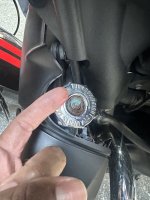
So it looks like I’m gonna have to do this myself the correct way. And that involves getting into the bleed bolt.

Do I have to remove anything to get to the bolt?
IMG_8099.jpeg
 
If the reservoir is at the right level wouldn’t simply running the bike work out any air bubbles trapped in the system? Recently flushed my radiator and opened the bleed screw in the process. Haven’t risen since so couldn’t say if it’s running hotter or not
In most cases yes, however there are cases where venting is required to be water solid. The water pump is great for moving water but doesn't move air very efficiently. The impellor design at low speed can allow air to just percolate in the suction eye and water isn't really moving well in the system. Over time the air will eventually work it's way to the high point in the system and stay there until vented out. The rad cap is the highest point in the system. One way to get to a water solid condition (desired) is slowly fill the radiator and allow air to move around the system venting out the rad filler port as coolant is added. Make sure the bike is not on the side stand when you fill as that will allow air to be trapped in the rad upper tank opposite the filler cap. Also, when the system is 'apparently' full let it sit overnight and check the next day. If it's still full to the top of the filler neck make sure the expansion tank has more than MIN coolant in it (close to MAX is OK). Then start the bike and let it idle. As temperature in the coolant rises the thermostat starts to open at 85C (185F) and the flow in the system increases, sweeping any trapped air through the system. At 103C (217F) the fan kicks on. The saturation pressure of water at 217F temperature is 276 psig so the system at 3 psig (lift pressure of the rad cap) is subcooled, but water at that temperature expands about 4% in volume. If the system is water solid the only place for an incompressible fluid to go to is the expansion tank from the rad cap lifting. If air is still in the system, it's compressible and system pressure won't rise to the lift setpoint of the rad cap until it's much hotter. As long as the system remains in stasis at that point the temperature, pressure, and volume all remain the same and that is the max temperature. If the rad cap is slow to lift the system pressure can increase above the normal setpoints and the system runs hotter at a higher pressure than before.
 
Last edited:
Looking more closely, the radiator cap is leaking coolant and the coolant is now below the main line and it’s been only 100 miles since I’ve rode the bike.

The dealership did not “burp” this bike and they just bull****ted me.
 

Attachments

  • IMG_8100.jpeg
    IMG_8100.jpeg
    146.7 KB · Views: 0
Looking more closely, the radiator cap is leaking coolant and the coolant is now below the main line and it’s been only 100 miles since I’ve rode the bike.

The dealership did not “burp” this bike and they just bull****ted me.
In tuneecu, you can have the cooling fan come on sooner, this probably won't fix existing problem but will allow fan to turn on sooner. Might try replacing thermostat, and you can also get one that opens at a lower temp.. Have you actually put a mechanical temp. gauge in radiator to watch temps?
 
Back
Top