
Rocket 3 Roadster Possibly Overheating?

R-III-R Turbo is correct. The 50-50 mix is to ensure the cooling system does not freeze in extreme low temperatures. In the summer you could run a very low mix of antifreeze in the system to prevent corrosion, and it will be fine.

Any coolant you buy off the shelf is typically a 50-50 mix of distilled water (evaporation process) or demineralized water (resin bed filtration process). The water is what actually does the cooling, so having more water than antifreeze makes the cooling system more efficient. Maximum efficiency would be 100% demineralized water alone in the cooling system, however there is a tradeoff for going that route. The anti-freeze component of the coolant mix provides corrosion inhibitors and has pump seal lubrication components in the fluid. Using only water would allow corrosion to build up in the system and could damage water pump seals. So, adding more water than anti-freeze has only one small drawback and that is reduction of the freeze protection in winter. If your winters are mild (rarely gets below 10F) you are probably safe since the freeze protection limit is stated on the bottle is -35F. Here in North Texas a 50/50 mix is overkill. If your area never gets that cold (-35F), then a 60/40 or 70/30 mix may be fine. To verify your freeze protection is within limits you can purchase a hydrometer to see what your coolant protection level is for about $5.00 at any auto parts store. Be sure to run the bike for a few hundred miles to ensure a few cycles through the expansion tank so the mix is homogeneous and you are good to go. If the protection isn't quite enough, add some straight antifreeze to the expansion tank and ride a few hundred miles and test again. You'll eventually get the mix and protection limits you want.

You can order a coolant tester from Amazon for about $5.50. To test your coolant, you draw up a sample from the radiator, and the pointer will indicate the protection temperature of the sample. You can return the sample to the radiator when done.
1784209121608.png
 
Last edited:
So…it is ok to put distilled water in my radiator for now? Is what I’m gathering lol Since I have coolant in the radiator already and I’m just trying to tap it off and get out any air from the bleed bolt, I’m good to go then.

So, I’m just waiting for my new radiator cap.
 
Yeap that's it.

And while we're at it. If ever in doubt about what coolant to top up with, just use deioniseded/distilled/demineralised water. It's cheaper and compatibility with all coolant (except expensive waterless coolant...).
Of course any significant top up will need the right coolant to keep the mixture somewhat right.
But the water will get you out of a jam and you can get it in any auto shop and even supermarkets in the car care bits section.
 
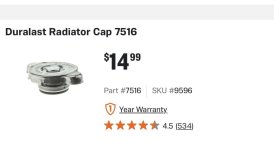
I wasn’t able to find the the caps you mentioned @atomsplitter , but I believe I found a near exact replacement for the Rad Cap. I was wondering if this is acceptable but most of all, safe.

Here’s the product link:


It’s probably overkill but I did buy the proper OEM, it just won’t be here for a while, and if this rad cap is good for my rocket, at least I have a spare part.
 

Attachments

  • IMG_8116.jpeg
    IMG_8116.jpeg
    37.1 KB · Views: 1
So…it is ok to put distilled water in my radiator for now? Is what I’m gathering lol Since I have coolant in the radiator already and I’m just trying to tap it off and get out any air from the bleed bolt, I’m good to go then.

So, I’m just waiting for my new radiator cap.
Yes, top up and seal up and you're golden.

A bit of understanding of your cooling system might help here. Water is the actual coolant because it has a very high specific heat capacity (symbol cp). If you raise the temperature of water to 212F it achieves 'saturation' meaning it can't hold any more heat without going thru a phase change. The amount of heat to change one pound mass water to one pound mass of steam at 212F (at atmospheric pressure) is 970 BTUs. That's a lot of BTUs (a BTU is defined as the amount of heat required to raise the temperature of one pound mass of water by one degree Fahrenheit at about 60°F). It's called the "latent heat of vaporization" and it's how the heat in your engine is moved from where it's produced in the combustion chamber to atmosphere flowing across the cooling fins of your radiator. Once water at atmospheric pressure reaches saturation adding heat will NOT raise its temperature, only vaporize the mass faster. One gallon of water has 8.34 pounds-mass so if your cooling system holds a gallon of water, it has the potential to hold 8090 BTUs circulating in the system. As you raise pressure on the water the BTUs it will hold goes UP before boiling occurs. That's why the cooling system of your motorcycle has a pressure relief cap to increase the total BTUs the system can remove effectively from the combustion process to atmosphere. To understand how your system was designed you need to know the heat load and how much has to be removed to maintain material properties desired (too much heat expands metal beyond operational limits). You can arrive at that heat value by calculating the total heat of the fuel burned per hour at full throttle for the maximum heat load. The cooling system can then be designed to remove that heat load plus an added safety margin of say 20%. To calculate the size of the heat exchanger needed (radiator) the engineers use that heat load value and how much air differential temperature is needed. That leads to how much water flow is needed to move those BTUs so the result is: Rate of Heat is equal to the mass flow rate times the differential temperature of the source to heat sink. Knowing that then gives you a pump flow rate required to maintain the system below the limits. The pump flow has to be calculated based on variable speeds since the engine has a rev range. After doing all the calculations the system is designed to handle the heat loads expected under all conditions.
 
Last edited:
I wasn’t able to find the the caps you mentioned @atomsplitter , but I believe I found a near exact replacement for the Rad Cap. I was wondering if this is acceptable but most of all, safe.

Here’s the product link:


It’s probably overkill but I did buy the proper OEM, it just won’t be here for a while, and if this rad cap is good for my rocket, at least I have a spare part.
It says it's vented so should be good to go as long as it seals the system.
 
Back
Top