
LiFePO4 Battery

shapa

Standard Bore
Joined
Nov 27, 2022
Messages
7
Location
UK
Ride
Rocket 3GT
I have moved to the Lithium battery on my Rocket 3GT because the standard one (Yuasa) is not holding well and takes longer to start the bike.

Many powerful bikes are already coming with LiOn / LiFePO4 batteries because they can deliver much better cranking power, are faster to charge, the weight is ~80% lower, have 8-10 years expected life, etc...

It was not easy to find a proper replacement - similar Wh batteries are bigger than the compartment, but then I saw the EU-made "lego-style" solution - you can buy 1-2-3-4+ batteries and connect them.

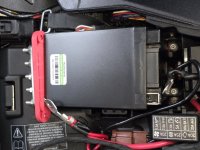
So I purchased 2x LiFePO4 Ultrabatt multiMIGHTY+ 400 (300CCA) batteries, stacked them (== 600CCA, vs 275 on the standard one), and it works well. They fit nicely in the compartment; in fact, some additional free space is available. The engine start is nearly instantaneous; it holds the charge for many weeks (and I've got an always active GPS tracker and alarm), complete charging is ~5 times faster, etc.
IMG_7020.jpeg
IMG_7036.jpeg
IMG_7021.jpeg
IMG_7029.jpeg
 
I installed a lithium on my new 23 Rocket. Keeping the oem in the garage on a tender for now as a back up.
Got mine at Batteries Plus. We have had 2 weeks of 10 - 25 F. Lows at night and it still cranks right up. The weight difference in batteries is amazing.
Befween the battery, tail tidy and removing the cat, the bike has lost almost 40 pounds.
 
Lithium batteries are not expensive today, but so many advantages. It is confusing why Triumph continues to supply the standard battery for such a powerful bike... To save a few quids?? Makes no sense.
 
Love the way those batteries stack, clip and connect together, very tidy, out of sight, no need for connecting cables on top. Lot of thought gone into that.

I started using Li-ion batteries many years ago both for bike and a pocket-size jump starter. Superior in all respects to wet cells, except cost. Though with the long life span maybe even that is not relevant. My two 13 year old batteries are still going strong.

And as with many products, as usage has increased, the prices have come down. But they are still dearer than wet cells, and vehicle manufacturers are very conscious of saving a few bucks wherever possible.

Still, I'd happily pay a few bucks more for the bike to have this technology. Isn't that what this new bike is all about?
 
Bumping up an old thread to see if others have gone the LiFePo route or similiar Li Ion battery replacement. It seems one of these batteries @shapa bought and installed is rated at 16Ah. The OEM Yuasa is rated at 18Ah, so a loss of capacity. However, the alternator on the bike should have no problem and a battery tender makes up for the rest. Reason I ask is trying to find ways to recapture a little storage space like I had on my R3T with a converted air box. I had tools, compressor, and tire plug kit as everyday carry so I was always prepared. On the new R3GT I have the plug kit, a quinchi multi-wrench, needle nose pliers, spare fuzes, and button batteries (FOBO tire sensors). Would like a spot for a mini-pump as well. Had thought of hollowing out a portion of the seat, but it is already so thin this was a non-starter. The space after those Li Ion batteries installed leads me to believe there might be just enough space for that pump. Any more than those three items would be what goes in a tail pack or saddlebag for longer trips.
 
Anti gravity in California makes a great battery, tested in very cold weather, keep from actually freezing and mine has been flawless, not cheap and is going on 6 years of abuse, 3lbs, 900cca, horror stories i hear are from cheap lipo batteries. Anti gravity is awesome!
 
I've been looking at Antigravity for my GT and it seems the only one that would fit is the ATX-12HD. The ATX-20 series are ~6.9" long while the stock battery is only 6.0". I don't think the battery tray has enough room for a 6.9" battery. Has anybody put an antigravity battery in their newer rocket?
 
I've been looking at Antigravity for my GT and it seems the only one that would fit is the ATX-12HD. The ATX-20 series are ~6.9" long while the stock battery is only 6.0". I don't think the battery tray has enough room for a 6.9" battery. Has anybody put an antigravity battery in their newer rocket?
I have a 25 R3 GT Storm and recently installed an Antigravity ATX20-HD - I had to place the battery on its side - then purchase 6gauge terminal wires with M6 /.25inch ends.
this serves to extend the cables - OEM will be too short... you just need to extend one .
I extended the positive end. I do not recommend using a LiFePO4 battery though!!
Two reasons: 1- the voltage can run as high 14.6V but usually stays between 14.4-14.6V
The recommended max voltage for Antigravity is below 14.4 V -running above 14..4V may
damage the charging system on your Rocket - the battery has protection and my shunt the
excess voltage to the charging system, potentially damaging your alternator.
Second reason: the temperature in our R3 battery compartment can get as high as 80 degrees Celsius/ 176 Fahrenheit especially when riding below 50 mph .. this happens because the battery box is sitting right next to the exhaust headers - also, the charging process builds up heat in the battery.
This temperature is above the recommended operating temp for the Antigravity battery.
In short, the R3 charging system is not ideal and the battery gets too hot. Temperatures above 150 Fahrenheit is harmful to LiFePO4 batteries. . Unless you install an updated regulator that delivers 13.6- 14.2 Volts and
modify the battery compartment to lower its maximum temperature below 150 Fahrenheit - you will potentially damage your alternator and or your LiFePO4 battery.
Go with OEM 320 CCA AGM update from Yuasa - better cranking and compatible charging.
 

Attachments

  • 20260522_162550.jpg
    20260522_162550.jpg
    193 KB · Views: 12
Last edited:
I have a 25 R3 GT Storm and recently installed an Antigravity ATX20-HD - I had to place the battery on its side - then purchase 6gauge terminal wires with M6 /.25inch ends.
this serves to extend the cables - OEM will be too short... you just need to extend one .
I extended the positive end. I do not recommend using a LiFePO4 battery though!!
Two reasons: 1- the voltage can run as high 14.6V but usually stays between 14.4-14.6V
The recommended max voltage for Antigravity is below 14.4 V -running above 14..4V may
damage the charging system on your Rocket - the battery has protection and my shunt the
excess voltage to the charging system, potentially damaging your alternator.
Second reason: the temperature in our R3 battery compartment can get as high as 80 degrees Celsius/ 176 Fahrenheit especially when riding below 50 mph.
This temperature is above the recommended operating temp for the Antigravity battery.
In short the R3 charging system is not ideal and the temp gets too hot for LiFePO4 batteries. . Unless you install an updated stator that delivers 13.6- 14.2 Volts and
modify the battery compartment to lower its maximum temperature below 150 Fahrenheit - you will potentially damage your alternator and or your LiFePO4 battery.
Go with OEM 320 CCA AGM update from Yuasa - better cranking and compatible charging.
The picture posted is me experimenting with different positions - I eventually went back to the original OEM set-up - but will be upgrading to the 320 CCA Yuasa AMG/ OEM dimentions.
 
Back
Top